


Onizarato Branding Site
Expert Interview

July 2024
confiture fumi
Highlighting Local Ingredients
Ten Varieties of Sugar Tailored to Each Ingredient
〈confiture fumi〉
A Specialty Confiture Atelier in Yoshino, Nara
Located in the scenic town of Yoshino in Nara Prefecture, confiture fumi is a dedicated atelier specializing in confiture. Owner Fumi Azuma creates a wide range of unique confitures using locally sourced ingredients, including rare selections like green tomatoes and ground cherries. She carefully selects from dozens of types of sugar to find the perfect match for each ingredient.
In this interview, we spoke with her about how she works with local produce and how she chooses different sugars—including Onizarato—to bring out the best in each creation.
【The Journey to Launching Confiture Fumi】
First, could you tell us about your background, Ms. Fumi Azuma, founder of the atelier confiture fumi?
confiture fumi was founded in 2006. Before that, Fumi Azuma worked in architecture. One year prior to launching the atelier, she was asked by a shop she had helped design to create a jam on the spot—an impromptu blend of apple and raspberry.
It was meant to be served over French toast, so instead of simmering it down like a jarred jam, she finished it more like a fruit sauce. The customers loved it, and the shop even began selling it by weight. That moment marked the beginning of her journey into confiture.
Later, I earned a certification as a vegetable sommelier and was invited by a local bakery to try making vegetable-based jams. I bought around 20 different kinds of vegetables at the supermarket, turned them into confiture, and brought them in. They loved it, and it was decided that the jams would be sold. That moment also marked the beginning of confiture fumi.


Narayamasou: A Café Surrounded by the Nature of Yoshino
So you originally started by creating jams and sauces to pair with bread and meals. When did you begin using the term “confiture”?
When I launched confiture fumi, I chose this name because I wanted to convey that what I was making was different from typical “jam.” In Japan, jam is usually sweetened and simmered with sugar to improve shelf life. But in France, confiture has a broader meaning—it refers to anything cooked with sugar, and it’s often used in cooking as well. I felt that this term better represented what I was creating.
You create many unique varieties of confiture, such as rhubarb and ground cherries. How do you go about selecting your ingredients?
Back when I was selecting vegetables at the supermarket, I looked for ingredients that seemed suitable for confiture. But once I began sourcing directly, my process shifted to starting with the producers themselves. Rhubarb and ground cherries, for example, came about simply because there happened to be growers in Nara. My approach is driven by the desire to turn the efforts of those working hard to cultivate ingredients in Nara into confiture.
【Crafting Confiture at confiture fumi】
Are the green and red tomatoes you use with Onizarato also sourced from local farmers?
Yes. The green tomato confiture is made from tomatoes that local farmers thin out to help the remaining ones grow larger. I source them the same day and cook them immediately.
“Green tomatoes” here refer not to a specific variety, but to unripe tomatoes that have been thinned out during cultivation.
Note: While there are tomato varieties that remain green when ripe, in this article, the term “green tomato” is used for convenience to refer specifically to thinned, unripe tomatoes.
Tomatoes are one of the vegetables with a high rate of waste due to thinning, especially at large farms where the amount discarded can be substantial. After receiving inquiries from farmers, we spent years experimenting to determine which green tomatoes, at which stage of growth, would be best suited for use. Through this process, we carefully refined our approach and eventually turned it into a product.

Freshly Harvested Green Tomatoes (Thinned Tomatoes)
(from confiture fumi official Instagram)

Green Tomato Confiture
(from confiture fumi official Creem)

Green Tomato Confiture
(from confiture fumi official Creem)
It’s especially well-received by restaurants. To achieve its vibrant color, the confiture must be cooked within 24 hours of harvest—something that’s only possible with a direct connection to the farmers. Very few people are able to process and distribute it under these conditions, which makes it highly sought after.
Since green tomatoes aren’t sold on the market, this confiture was only possible thanks to a direct connection with the farmers.
Most farmers don’t process their own produce, and green tomatoes like these wouldn’t sell well if simply displayed raw. I believe most of them end up being discarded.
In agriculture, it’s inevitable that some produce will be thinned out or have imperfect shapes despite being delicious. As I continued my work, my connections with farmers naturally grew. During peak harvest seasons, farmers are extremely busy shipping fresh produce, so I take on the role of handling processed goods. I hope that in doing so, I can support them in some small way.
How did you go about developing something with no precedent, like the green tomato confiture, and bringing it to completion?
It was a long and winding process, but I enjoy starting from zero. I tried every possible method myself and tasted every version. Whether to peel the tomatoes or not, remove the seeds or leave them, cut them into wedges, dice them, or blend them—each variation was tested. I experimented with different sugars too: soft white sugar, granulated sugar, and Onizarato.
I would make multiple prototypes, adjust the cooking methods and ingredients, then taste them again three months later to check how they aged. After that, I’d start over from scratch. It usually took over a year to finalize a product. It may seem inefficient, but I spent about three years working this way, and through that experience, I began to recognize patterns—like how plums and Japanese sumomo behave similarly. That helped me streamline the process.
At first, I was working with around 30 types of sugar, but now I’ve narrowed it down to about 10.
After testing around 100 variations using two tomato varieties—Reika and Momotaro—we concluded that Onizarato is the best sugar for tomatoes. Now, regardless of the variety, we always start with Onizarato when working with tomatoes.
What made Onizarato the ideal choice for tomatoes?
It was the way Onizarato brought out the natural sweetness of tomatoes. Tomatoes develop a richer flavor when heated, but even accounting for that, I found that Onizarato best highlights their unique sweetness.
The cooking method also plays a role. For example, when making strawberry confiture, I coat the raw strawberries with sugar to let it absorb, so I use fine-grained sugar. But with tomatoes, I heat them first and add the sugar afterward, which means the larger crystals of Onizarato aren’t a problem. In fact, because it dissolves more slowly than other sugars, I believe it actually contributes positively to the final result.
【How We Choose and Use Different Sugars】
Finally, we’d like to ask about how you choose different types of sugar for your confitures.
In your Nanko-ume confiture, you offer one version made with white sugar, and another made with granulated sugar and honey. What differences were you aiming to highlight between these two?
When cooked with white sugar, the acidity of the ume becomes milder, so for jarred products, I typically use the combination of Nanko-ume and white sugar. The version with granulated sugar and honey was created at the request of a beekeeper who asked me to make a honey-based confiture. In that case, I intentionally used granulated sugar to preserve the tartness of the ume and let the honey shine.
Interestingly, when you add granulated sugar to something sour, it creates a sensation of “being sour, yet gradually becoming sweet.”

confiture fumi Bottled confiture
So the sweetness increases, but the tartness stays the same—is that right?
Exactly. Even when using the same amount of sugar, the version cooked with white sugar results in a milder flavor with the acidity toned down, while the one made with granulated sugar retains its tartness—it lingers on the tongue.
Wouldn't using Onizarato make it even more tart?
If someone says, “I want a really tart confiture,” or “I’m looking for something like a sour sauce to serve as part of a dish,” then I might intentionally cook it with Onizarato to enhance the acidity.
Whether tartness is desired, bitterness needs to be softened, it's for bottling, or it's a sauce to be served in a restaurant—
I choose the type of sugar based on the specific situation.
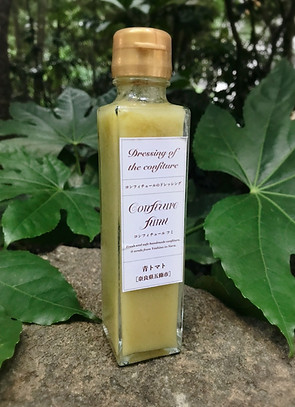
Green Tomato Confiture Dressing
Expanding the idea of confiture at confiture fumi
Comfiture fumi NARAYAMASOU
Address:
881 Yanagi, Yoshino-cho, Yoshino-gun, Nara Prefecture
Phone: 0746-35-7003
Business Period:
Open from mid-March to the end of December
(Closed for winter from January to early March)
Irregular holidays. Please check the Narayamasou website for details.
Opening Hours:
11:00 AM – 4:30 PM (Last order: 4:00 PM)
Lunch available by reservation only. Phone reservations accepted until 4:30 PM.
